
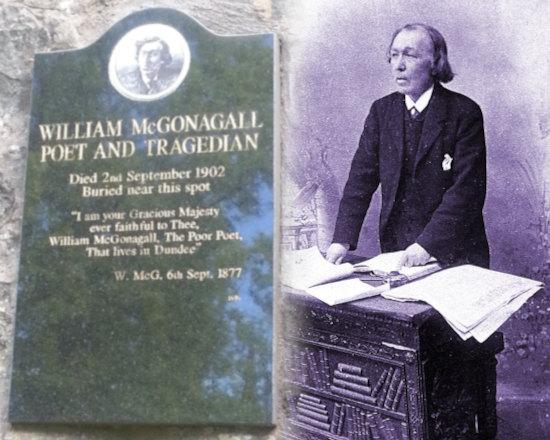
The latest instalment of our strand investigating the denizens of Greyfriars Cemetery marks a departure from previous episodes for two reasons. First: It centres upon not a contemporaneous gravestone but a plaque erected after the fact, alluding vaguely to an otherwise unmarked grave whose exact position is unknown (having been unmarked, and all). Second: The subject happens to be a bonafide CELEBRITY! (Not just the grandfather-in-law of one.) Rest assured, normal service will be resumed in forthcoming episodes (probably).
Robin Mitchell is (almost sort of not really) related to a poet and he didn't know it.
Overworked and underpaid accomplice Cousin David has been at it again. He continues to unearth (so to speak) gems of information from Edinburgh's Greyfriars Cemetery. His most recent challenge was to research the poet, William McGonagall.
The first thing to know about McGonagall's grave in Greyfriars is that it is unmarked; a pauper's grave. Although he had known no little notoriety in his lifetime, it had been on balance mostly the negative sort, and his fame had never been accompanied by fortune. That fame did grow in his absence, but still it was almost a century before his most ardent admirers were able to arrange a memorial of any kind in the kirkyard near where he was buried. In 1999, a plaque was affixed to the boundary wall in the Victorian annex known as the West Yard, believed to be closest to the grave's approximate location.
The William McGonagall plaque reads:
William McGonagall
Poet and Tragedian
Died 2nd September 1902
Buried near this spot"I am your gracious Majesty
Ever faithful to thee,
William McGonagall, the poor poet
That lives in Dundee"
McGonagall wanted to be the Poet Laureate, so he wrote to Queen Victoria at Balmoral in rhyme. The above is the last four lines from the poem he sent called A Requisition To The Queen. He received a reply from the Royal household which pretty much said: Thanks, but no thanks. McGonagall however only seemed to pay attention to the first part, taking the expression as an irrefutable sign of appreciation from Her Britannic Majesty herself. So convinced was he, that in 1878 he walked sixty miles through a thunderstorm in an attempt to perform for the Queen at Balmoral Castle, bearing the letter as credential; the Royal footmen were unconvinced, and back to Dundee he trudged.
William McGonagall wrote about 200 poems, including The Tay Bridge Disaster and The Famous Tay Whale which are widely regarded as some of the worst in English literature. Although, we love them.
The Tay Bridge Disaster (first verse)
Beautiful Railway Bridge of the Silv'ry Tay!
Alas! I am very sorry to say
That ninety lives have been taken away
On the last Sabbath day of 1879,
Which will be remember'd for a very long time.
The Famous Tay Whale (first verse)
'Twas in the month of December, and in the year 1883,
That a monster whale came to Dundee,
Resolved for a few days to sport and play,
And devour the small fishes in the silvery Tay.
William McGonagall died a pauper in 1902 in Edinburgh's South College Street. A plaque above the entrance shows an image of McGonagall with the inscription:
William McGonagall
Poet and Tragedian
Died Here
29 September 1902
Cousin David discovered that William McGonagall's children were often in trouble with the law and were regular visitors to Dundee's court. Many of these events were recorded in the local newspaper of the day. One example is the following.
"John McGonagall, twine-spinner, Step Row, and Peter Bobbins were charged with disorderly conduct in the Perth Road on Monday night, and McGonagall was further charged with having assaulted Constable Menzies after he was in custody. Bobbins failed to appear. McGonagall pleaded not guilty, but was convicted on evidence, and fined 30 shillings, or twenty days in prison."
The McGonagall name was resurrected in the 1950s by comedian Spike Milligan. A character called "Charles McGoonagall" frequently appeared in the Goons Radio Show, alternately played by Milligan and Peter Sellers. A 1974 movie called The Great McGonagall starred Spike Milligan as a fictionalised William McGonagall and Peter Sellers as Queen Victoria. Despite (or perhaps, McGonagallesquely, encouraged by) the film's critical panning, Milligan followed up with a trilogy of spoof biographies into the 1990s.
Then in 1997, the character Minerva McGonagall appears in the book Harry Potter and the Philosopher's Stone although it's unlikely J. K. Rowling took the name from this plaque, as the plaque was not unveiled until 1999.
The unveiling of the plaque was attended by McGonagall's great great grandson William, and his great great great granddaughter Mary Ross.
So, talking of relations, here is Robin Mitchell's connection with McGonagall. Cousin David, while ploughing through the invaluable resource that is Scotland's People, noticed the name Dr Ronald Summers. He recognised this as a family name. It was Robin's first cousin's wife's grandfather -- stay with us -- who certified the death of William McGonagall's grandson. Yes, that's what you read.
Robin's first cousin is Thomas Wilson and his wife is Ailsa Summers. Her grandfather was Dr Ronald Summers, and he certified the death in 1944 of William McGonagall's illegitimate grandson, Andrew McGonagall.
I know. It's a tenuous connection which dare we say, is very McGonagall.