
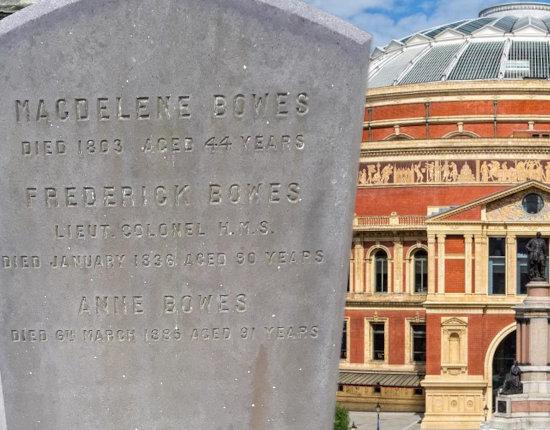
I'd imagine while you walk through Edinburgh's historic Greyfriars cemetery, you're unlikely to be thinking about the Royal Albert Hall in London and a type of cement named after a British army major's daughter. Well, thanks to our resident genealogist, known in-house by the nom de guerre Cousin David, we have a connection to both.
However, before we get to that, we should explain a little about Cousin David. Since 2019, our co-founder Robin Mitchell's cousin has been set a weekly challenge from Greyfriars cemetery. Robin sends him a photograph of a gravestone and asks him to search for historical and anecdotal information relating to the family in question. More often than not Cousin David provides a comprehensive family tree with nuggets of fascinating information which Robin then relays on his walking tours of Greyfriars cemetery. To date Cousin David has researched over 100 graves.
Recently Cousin David provided Robin with intriguing details relating to a small unassuming gravestone bearing the names of Magdelene Bowes, Frederick Bowes and Anne Bowes.
The full inscription on the gravestone reads:
MAGDELENE Bowes
Died 1803 aged 44 Years
Frederick Bowes
Lieut Colonel HMS
Died January 1836 aged 90 years
Anne Bowes
Died 6th March 1885 aged 91 years
Magdelene was from County Tipperary and Lieutenant Colonel Frederick Bowes married her while his regiment was stationed in Ireland. Frederick lived to the grand old age of 90; while Anne Bowes, Frederick and Magdelene's daughter, also lived into her 90s.
Lieutenant Colonel Frederick Bowes was a resident of Edinburgh's New Town, residing at 20 Albany Street. He was connected to several British military regiments in his time: the 12th Regiment of Foot, 64th Regiment Foot and the 82nd Regiment of Foot.
Cousin David was delighted to discover that Frederick and Magdelene's granddaughters, Madelene Bowes and Ellen Selina Bowes, married two brothers, Robert Anthony Edwards Scott and Henry Young Darracott Scott (respectively).
Okay, stay with it. We're getting to the Royal Albert Hall and cement connection.
Ellen Selina Bowes married Henry Young Darracott Scott in 1851. He was an English Major-General in the Corps of the Royal Engineers and instructor in surveying at the Royal Engineer establishment at Brompton, Chatham. At Chatham he oversaw the chemical laboratory, and his experiments enabled him to perfect the selenitic lime (named after Ellen Selina) which also goes by his name: 'Scott's Cement'. It was designed to make lime mortar behave more like cement.
Scott was joint designer (with Francis Fowke) and builder of London's Royal Albert Hall. Henry's design for the domed roof of the Royal Albert Hall was unique and ambitious: the iron frame weighed 338 tonnes and had to support 279 tonnes of glass. There were many predictions that the roof might collapse. When the day arrived to remove the scaffolding supporting the roof, Scott sent everyone out of the building, and he himself knocked away the final support. The dome dropped just 8mm before settling into position on the supporting walls of the Hall, where it has remained ever since. Queen Victoria opened the Royal Albert Hall in 1871.
Now the question on everyone's lips, of course, is: Was selenitic lime used in the construction of the Royal Albert Hall? And the answer is a resounding "Yes!" Scott's specialized lime, which incorporated gypsum to enhance strength and setting time, was employed in the structure's mortar.
So, next time you visit Greyfriars cemetery, you should pay your respects to the Bowes family. The gravestone is located very close to the famous Bum Tree.