
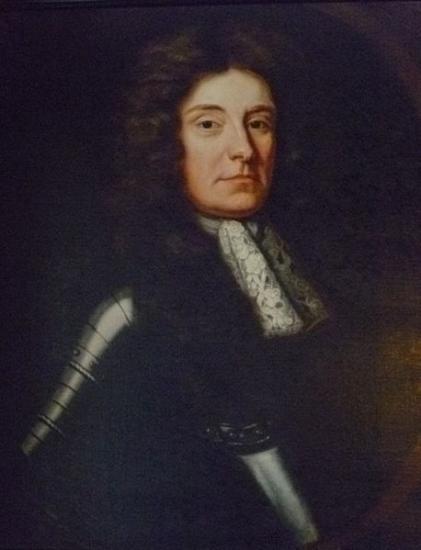
On this date in 1681 Archibald Campbell, 9th Earl of Argyll, made an implausibly brazen escape from Edinburgh Castle, where he was being held awaiting death for treason against King Charles II.
Campbell had inherited his title after the Restoration, his father having been beheaded in 1661 for collaborating with Cromwell's government during Charles II's exile. He had made great effort to distance himself from his disgraced forebear. However, while he had disarmed and disbanded the forces his father had commanded, he had also opposed their further persecution and, most importantly, strongly disagreed with the substance of the Scottish Test Act, issued in August of 1681 (and distinct from the earlier English Test Acts).
The Act required anyone seeking or already holding public office to take an oath, first and foremost, of their devotion to the Protestant faith. However, after that the subject also had to swear absolute obedience to the King in all matters, including religion. Further, it required them to accept and obey Charles's chosen heir, and members of the Royal family were exempt from having to take it. This was significant since James, Charles II's brother and heir presumptive (later James II/VII), was openly Catholic.
Although it was carefully worded so as to seem supportive of the Protestant faith, it was not difficult for Charles's more hardline subjects to detect the loopholes. Since the entire point of the Civil War had essentially been to remove Catholic authority and Monarchical tyranny from Britain, the prospect of a devoutly Catholic monarch wielding the powers granted him by the Test Act seemed, to a great many people, like a total reversal of those hard-won reforms.
Nonetheless, Campbell again tried his best to be obedient to his King, but his conscience prevented him from taking the oath without adding the fatal qualification: "...as far as it is consistent with itself and the Protestant religion."
This was not a caveat that King Charles could overlook, since the Earldom of Argyll brought with it tremendous power, making the Earl effectively King in all but name of much of the West of Scotland. Even the merest hint of rebellion in such a figure was far too great a danger, and so Campbell was immediately arrested and placed on trial for treason. The jury, made up almost entirely of his political and personal enemies, quickly found him guilty and sent word to Charles II (then in England) asking for his sentence.
Certain that his execution was imminent (there being no real prospect of clemency from Charles), Campbell decided not to wait for his reply. He was right to doubt the King's mercy: Charles' order for his death arrived on the 22nd, meaning it was sent as soon as confirmation of the verdict arrived, having likely been written in advance. He conceived an escape plan which, on the face of it, was so absurdly simple that any reasonable person would dismiss it immediately -- which might be exactly why it worked.
His daughter-in-law, Lady Sophia Lindsay, obtained permission to visit him in his confinement. She brought with her a servant who, she claimed, had recently been in a rather serious fight, resulting in severe facial injuries. That of course explained the bandages in which his head was entirely swathed, completely obscuring his identity. If you can see where this is headed, you are more astute than the entire garrison of Edinburgh Castle! The naïve-seeming scheme was to have Campbell swap clothes and wigs with the servant, wrap his head in bandages, and simply walk out of the building with Lady Sophia after her visit.
The Lady, demonstrating what must have been Oscar-worthy acting ability, left Campbell's quarters in floods of tears, and was escorted by her "servant" back to her coach. Outside, Campbell ingeniously climbed onto the back of the coach rather than into it, preventing anyone from realising that he was a member of the aristocracy by proving that he could maintain a grip on a moving vehicle. Once outside the Castle's bounds, he slipped quietly off down an alleyway to a friend's house, from which he was smuggled under the name "Mr Hope" down to London.
After his escape, the Earl disappeared for much of his remaining life. Naturally, as a fugitive (and now actively engaged in resistance to the coming succession of James), his location was kept a closely guarded secret, although a few letters revealing his general location and activities remain.
However, he returned to Scotland in style in April 1685, at the head of an invading army supporting the Monmouth Rebellion against James II/VII (who had taken the throne in February, following Charles II's death). He made several raids, which varied in success between "fleeting" at Inverary and "utterly pointless failure" at Greenock. His forces gradually dwindled until he was left with only his son John and three friends. After being refused shelter by an old servant, they were arrested in June 1685.
Campbell was immediately re-tried and sentenced to die exactly as his father had, beheaded at the Mercat Cross in Edinburgh twelve days after his arrest. Surprisingly, he was again allowed a visit by his wife and daughter-in-law prior to his execution, although this time there was presumably someone on hand to check that neither of the ladies leaving the premises after their visit were other than they appeared.